


Page 15 - KNORR Pneumatic Disc Brake
P. 15
5


                                                                         Functional and Visual Check


         5     Functional and Visual Check

         5.1  Wear Check of Pads and Brake Discs


               For optimum safety, the pad and disc wear limits
               must not be exceeded.


         Brake Pads
         The thickness of the pads must be checked regularly
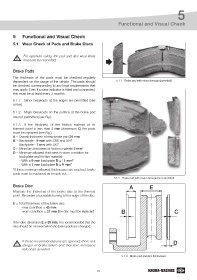
         dependent on the usage of the vehicle. The pads should        5.1.1 - Brake pad with minor damage (permitted)
         be checked corresponding to any legal requirements that
         may apply. Even if a wear indicator is fitted and connected,
         this must be at least every 3 months.

         5.1.1.  Minor breakouts at the edges are permitted (see
         arrow).

         5.1.2.  Major breakouts on the surface of the brake pad
         are not permitted (see Fig.).

         5.1.3.  If the thickness of the friction material at its
         thinnest point is less than 2 mm (dimension C) the pads
         must be replaced (see Fig.).
         A = Overall thickness of new brake pad 30 mm
         B = Backplate - 9 mm with SN6 and SN7
             Backplate - 7 mm with SK7 .
         C = Minimum thickness of friction material 2 mm*
         D = Minimum allowed thickness in worn condition for
             backplate and friction material:
             - With a 9 mm backplate D = 11 mm*
             - With a 7 mm backplate D = 9 mm*
         *If these minimum allowed thicknesses are reached, brake
         pads must be replaced as an axle set.
                                                                      5.1.2 - Brake pad with major damage (not permitted)

         Brake Disc                                                            A           E
         Measure the thickness of the brake disc at the thinnest
         point. Be aware of possible burring at the edge of the disc.

         E = Total thickness of the brake disc
               new condition = 45 mm
               worn condition = 37 mm (the disc must be replaced)         B                               C


         If the disc dimension E ≤ 39 mm, it is recommended that the
         disc should be renewed when the brake pads are changed.


               If these recommendations are ignored, there is a                                           D
               danger of brake failure and therefore increased
               risk of an accident.

                                                                          5.1.3 - Brake pad and disc thicknesses


                                                            15

