


Page 16 - KNORR Pneumatic Disc Brake
P. 16
5


        Functional and Visual Check


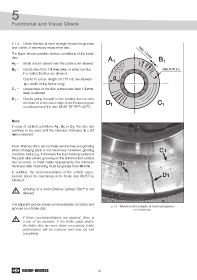
        5.1.4.   Check the disc at each change of pads for grooves
        and cracks. If necessary replace the disc.
        The figure shows possible surface conditions of the brake                    max. 1.5 mm
        disc.                                                     A                              B
        A  =   Small cracks spread over the surface are allowed      1                              1
          1
        B  =   Cracks less than 1 5 mm deep or wide, running                                       max. 0.75 x a
          1
               in a radial direction are allowed
               Cracks to a max. length of 0.75 x’a’ are allowed      a
               (a = width of the friction ring)
        C  =   Unevenness of the disc surface less than 1 5 mm
          1
               deep is allowed
        D  =  Cracks going through to the cooling duct or onto
          1
               the inner or to the outer edge of the friction ring are    D 1                   C  1
               not allowed and the disc MUST BE REPLACED.


        Note:
        In case of surface conditions A , B  or C , the disc can
                                   1
                                       1
                                             1
        continue to be used until the minimum thickness E = 37
        mm is reached.
        Knorr-Bremse discs are normally service-free and grinding
        when changing pads is not necessary. However, grinding                                   C1
        could be useful, e.g. to increase the load-bearing surface of
        the pads after severe grooving on the entire friction surface
        has occurred. To meet safety requirements, the minimum          B1
        thickness after machining must be greater than 39 mm.
        In addition, the recommendations of the vehicle manu-
        facturer about the machining of the brake disc MUST be                                     D1
        followed.

               Grinding of a Knorr-Bremse Splined Disc® is not
               allowed.


        The adjacent picture shows some examples of cracks and      5.1.4 - Tolerances and examples of cracks and grooves
        grooves on a brake disc.                                                  on a brake disc.

               If these recommendations are ignored, there is
               a risk of an accident. If the brake pads and/or
               the brake disc are worn down excessively, brake
               performance will be reduced and may be lost
               completely.


                                                            16

