


Page 22 - KNORR Pneumatic Disc Brake
P. 22
5


        Functional and Visual Check


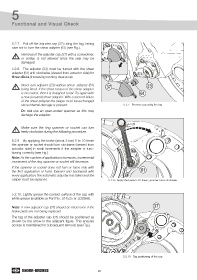
        5.2.7.  Pull off the adjuster cap (37) using the tag, taking
        care not to lose the shear adapter (61) (see Fig.).

              Removal of the adjuster cap (37) with a screwdriver,
              or similar, is not  allowed since  the seal  may be
              damaged.
        5.2.8.  The adjuster (23) must be turned with the shear
        adapter (61) anti-clockwise (viewed from actuator side) for
        three clicks (increasing running clearance).

              Never turn adjuster (23) without shear  adapter (61)   37                   23
              being fitted. If the shear torque of the shear adapter
              is exceeded, then it is designed to fail. Try again with                61
              a new (unused) shear adapter. With a second failure
              of the shear adapter the caliper must be exchanged
              since internal damage is present.                             5.2.7 - Remove cap using the tag
              Do not use an open-ended spanner as this may
              damage the adapter.


              Make sure the ring spanner or socket can turn
              freely clockwise during the following procedure.

        5.2.9  By applying the brake (about 2 bar) 5 to 10 times
        the spanner or socket should turn clockwise (viewed from
        actuator side)  in  small  increments if the adapter is func-
        tioning correctly (see Fig.).
        Note: As the number of applications increases, incremental
        movement of the ring-spanner or socket will decrease.
        If the spanner or socket does not turn or turns only with
        the first application or turns forward and backward with                      61
        every application, the automatic adjuster has failed and the
        caliper must be replaced.                                  5.2.9 - Apply the brake 5-10 times, spanner turns clockwise


        5.2.10. Lightly grease the contact surface of the cap with
        white grease (available as Part No. II14525 or II32868).

        Note: A new adjuster cap (37) should be fitted even if the                            37
        brake pads are not being replaced.
        The tag of the adjuster cap (37) should be positioned as
        shown by the arrow in the adjacent figure. This ensures
        access is maintained for subsequent removal (see Fig.).


                                                                           5.2.10 - Tag positioning of the cap


                                                            22

