


Page 21 - KNORR Pneumatic Disc Brake
P. 21
5


                                                                         Functional and Visual Check


         5.2   Adjuster Check
              Before starting work, ensure that the wheels are
              chocked and the vehicle cannot roll away.
              Ensure that service brake and parking brake,
         as well as bus stop temporary hold brake, if
         fitted, are in the released condition.


         Remove wheel (refer to vehicle manufacturer’s recommen-
         dations).
         5.2.1.  If, due to the orientation of the caliper on the axle,
         there is no danger of the brake pads falling out, remove the
         pad retainer (11) (see Section 6.1.2).


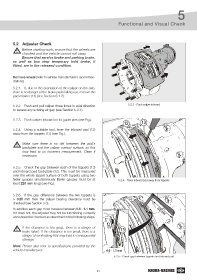
         5.2.2.  Push and pull caliper three times in axial direction         5.2.3 - Push caliper inboard
         to assess any existing air gap (see Section 5.3.1).


         5.2.3.  Push caliper inboard on its guide pins (see Fig.).
                                                                            12         13

         5.2.4.  Using a suitable tool, lever the inboard pad (12)
         away from the tappets (13) (see Fig.).


               Make sure there is no dirt between the pad‘s
               backplate and the caliper contact surface, as this
               may  lead  to  an  incorrect  measurement.  Clean  if
               necessary.


         5.2.5.  Check the gap between each of the tappets (13)
         and inboard pad backplate (12). This must be measured
         over the whole tappet surface of both tappets using two
         feeler gauges simultaneously (feeler gauges must be at          5.2.4 - Press inboard pad away from tappets
         least 220 mm long) (see Fig.).


         5.2.6.  If  the  gap  difference  between  the  two  tappets  is
         >  0  25 mm  then the caliper bearing clearance must be
         checked (see Section 5.3).
         In addition each gap must measure between 0 6 - 1 1 mm
         If it does not, the adjuster may not be functioning correctly                          220 mm
         and should be checked as described in the following steps.


               If the clearance is too great, there is a danger of        13
               brake failure. If the clearance is too small, there is a
               danger of overheating that may lead to consequential
               damage.

         Note: Please also refer to specifications provided by the
         vehicle manufacturer.                                   0.6 - 1.1 mm

                                                                      5.2.5 - Check gap between tappets and inboard pad


                                                            21

